
The Phainopepla
Against the Age of the Last Man

qtip_33
There’s a harrowing line in Doctor Zhivago. Russia is staggering out of revolution. Aristocrats are gone, religion is illegal, committees now tell you where you live and what you do. Pasternak observes,
In the days of the triumph of materialism, matter turned into a concept: food and firewood were replaced by the provision and fuel question.
There’s a whole political philosophy in that sentence. As power moves away from ordinary, everyday life (Alltaglichkeit), it deals with concepts instead of reality. Bread, wood, warmth become abstractions.
Nietzsche once wrote in Thus Spake Zarathustra that everything within the state is a lie. With his usual bravado, he’s similarly pointing. The larger and more layered institutions become, we lose a “people” for “the public,” “the masses,” or neatly categorized identities ready for technocratic analysis.
All of which is a roundabout way of explaining why my favorite bird is the phainopepla.
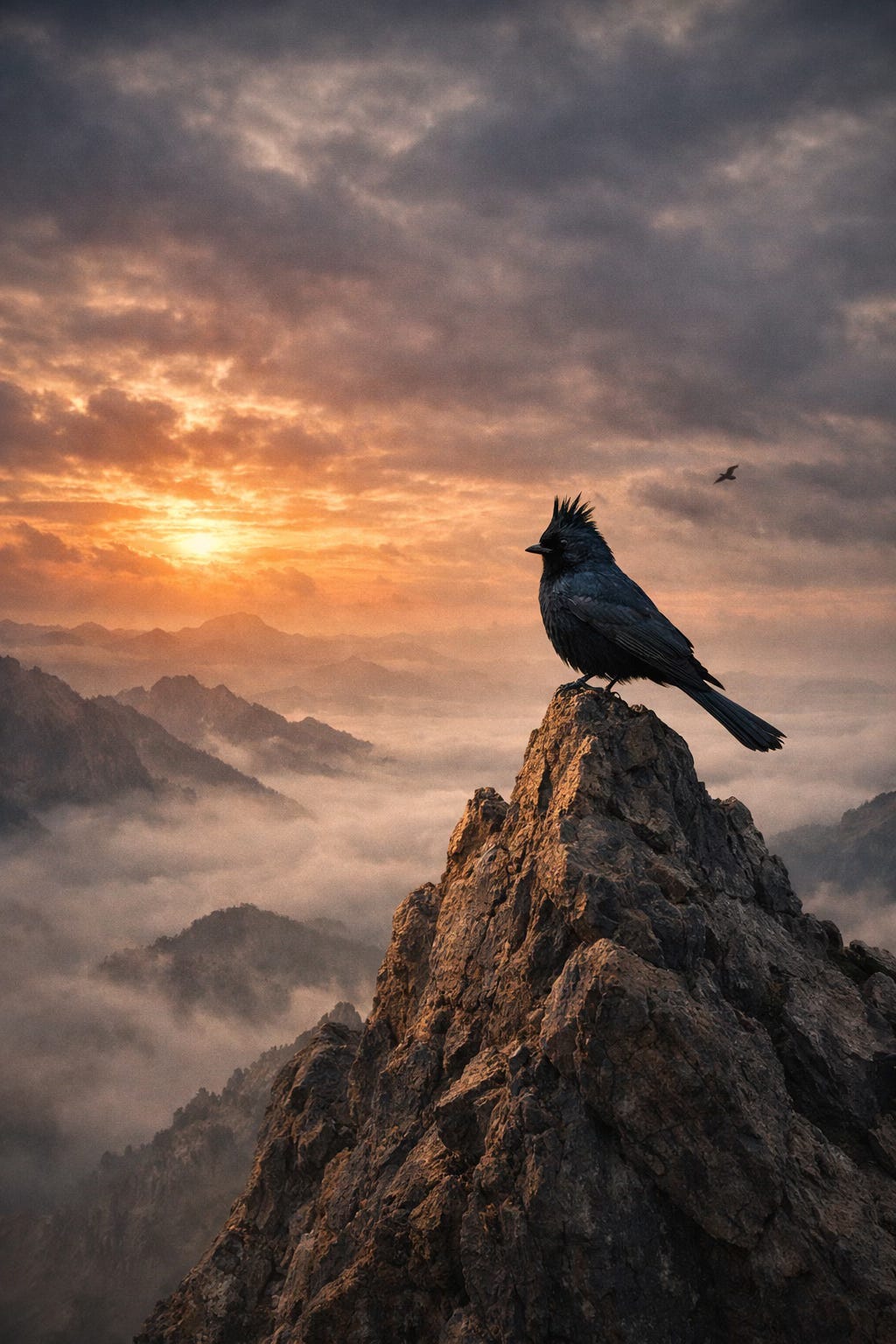
The phainopepla is about the size of a mourning dove but leaner, sharper. The males are black with a blue sheen that looks almost liquid or techy; the females are gray, though even they carry a soft silver tint. The name comes from the Greek: phaino (to appear or shine) and peplos (robe). A shining robe. The kind of robe you’d drape on a prize fighter who just won.
It lives across the American Southwest, where it savors mistletoe and snatches insects mid-air. It almost never drinks water, which seems a sort of masculine negligence, and imitates the calls of other birds. Not ‘imitate,’ so much as ‘mock.’
For the phainopepla has personality, let me tell you.
I had just moved into a deserty area and was running through a stretch of forest. A phainopepla landed on a branch about six feet in front of my face and stated cawing at me. Not tweeting or singing. A loud, aggressive barking.
I stopped. Maybe there was a nest nearby.
The bird kept yelling, so I continued. The phainopepla flew to another branch ahead of me with its belligerent cawing the whole way. Then another branch as I passed, then another. The bird escorted me down the road like I had just caused his car to veer into a tree.
It was like being chirped incessantly on the ice. Was I supposed to drop my gloves and swing at this guy?
Needless to say, there was no patient birding required to identify that one.
Later I learned that phainopeplas are territorial, solitary, and protective in the desert, but in the woodlands they nest communally with several birds sharing one tree. Fierce individualist in one setting, decent neighbor in another.
This bird embodies the American spirit, or at least an energy that might revive it. Thomas Jefferson wrote,
The spirit of resistance to government is so valuable on certain occasions that I wish it to be always kept alive…I like a little rebellion now and then. It is like a storm in the atmosphere.
That’s the phainopepla: resistance when resistance is called for; neighborliness when community calls.
More important, though, it refuses to be neatly managed from above.
Sure, with enough contraptions and subterfuge, you could cage a phainopepla. But I hope that bird is smashing into bars and yelling in your face the whole time.
I’d rather see that energy loosed into productive life, where smaller communities form on their own. Suppress it, and you do not get harmony. You get abstractions. The food question: how do I get it to eat in its cage? The hygiene question: how do I clean the cage without its escaping or injuring me?
But, yea, let it go free and you’re going to get dressed down every now and then.